Country
This land was never empty.
Before the road, before the lodge, before the lake had the name on the map, this was — and is — Aboriginal land. What follows is the story as far as we have been able to learn it from the public record. It is told with care, and it is not finished.
Awaba
The lake had a name first
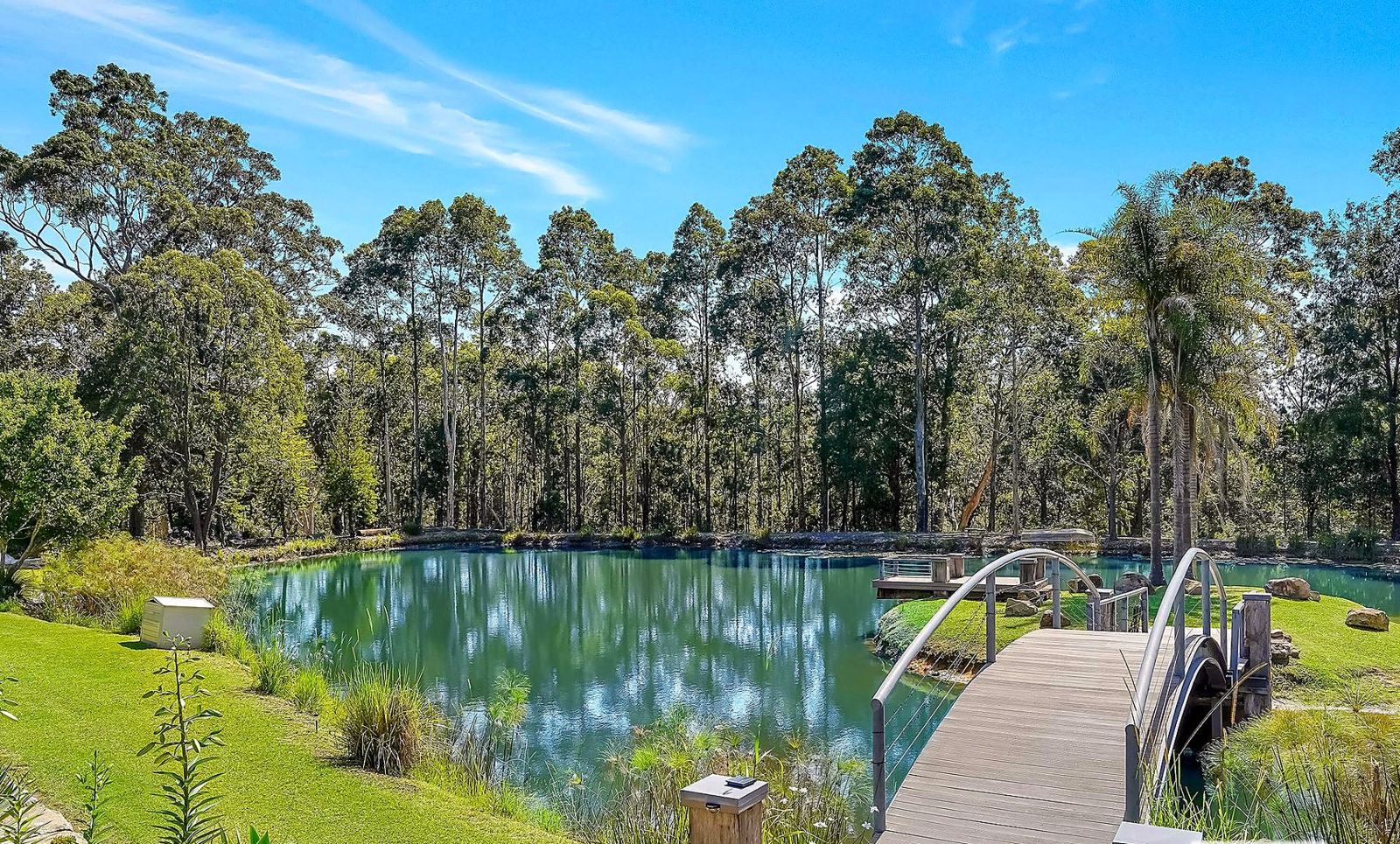
The water this bush drains into is called Lake Macquarie on every sign and map. It was called Awaba long before that. Awaba is the Awabakal word for the lake, and the people took their name from it: the Awabakal, the people of Awaba.
Lake Macquarie City Council, whose area this property sits in, names the Awabakal as the first people of this land, and acknowledges their Elders past, present and future. The published histories of Wyee and of Mandalong, the parish this property sits in, say the same. We follow that lead.
The edge of things
Where Countries meet
We are at the very southern end of the lake, where the Awabakal story meets the story of the Darkinjung. The Darkinjung Local Aboriginal Land Council describes its own area as running from Catherine Hill Bay in the north to the Hawkesbury in the south, and from the ocean west to the Watagan Mountains — which is to say, right alongside us.
The modern map is layered on top of that. Under the NSW land-rights system, the government's own boundary data places this road inside the Bahtabah Local Aboriginal Land Council area, with the Biraban Land Council just to the north around Morisset and Mandalong, and Darkinjung to the south and west. Those are statutory lines, not traditional ones. They tell us who to ring; they do not tell us whose story this is.
So we are not going to pick one name because it makes a neater sentence. The people who can say whose Country this is are the custodians themselves, and we are asking them.
Wyee
A place of fire
The nearest town, Wyee, carries a word that is said locally to come from Awabakal — a word for fire, or a place of bushfires. We have not found a linguist's record or an official naming entry to confirm that, so we hold it lightly. But anyone who has stood in this bush in December, with the stringybark hanging in strips and the air smelling of oil, will understand why the story has stuck.
The settlers' name came later and sideways: a railway siding on the northern line, first called Norahville after the nearest coastal village, then renamed for the place it actually stood in. In the long view of this ground, all of us — the sawmillers of the 1870s, the retreat that gave the place its rainbow, and the custodians of today — are very recent.
1825
Biraban, and the man who wrote the language down
In the mid-1820s a missionary named Lancelot Threlkeld set up on the eastern shore of this lake, at a place the Awabakal called Bahtahbah, near what is now Belmont. He did something few colonists of his time did: he sat down and learned the language properly. He could not have done it alone. His teacher was Biraban, a senior Awabakal man the colony also called M'Gill, whom the governor of the day described as the king of the tribe at Lake Macquarie.
Out of that collaboration came An Australian Grammar, published in Sydney in 1834 — one of the earliest serious written records of any Aboriginal language on this continent. The mission itself moved across the lake to Ebenezer, near Toronto, and closed at the end of 1841. Biraban died in Newcastle in 1846. The words he gave Threlkeld are still being read, and still being spoken; the Awabakal language is being revived today from the pages they made together.
We tell this not because the mission is a comfortable story — it is not — but because the language of this Country survived in part through one Awabakal man's patience with a stranger. That seems worth remembering on a property whose whole purpose is people learning to listen.
In the stone
What cannot be moved
Across this part of New South Wales, Aboriginal people left marks in the sandstone that are still there: grinding grooves, the long oval hollows worn into flat soft rock where stone axes were shaped and sharpened, usually beside water; and engravings cut into open rock platforms. They are not decorations. They are a record of thousands of years of work, teaching and ceremony, and they are of high cultural significance to Aboriginal people today.
A groove cut into a rock shelf cannot be picked up and moved. If it is damaged, it is gone. That is why NSW law treats harm to an Aboriginal object as a strict liability offence — meaning that not knowing, or not meaning to, is no defence. The only protection is to do the work first: search the state's register of recorded sites, follow the due-diligence process, and, where there is any doubt, engage the right Aboriginal people before a single machine touches the ground.
There are recorded sites in this district. Their locations are not published, by convention and by law. What we can say is what we are doing about it.
Our commitments
What this Country asks of us
Nothing breaks ground first
No new tracks, footings, gardens or road grading until a heritage search and a proper due-diligence assessment are done. Where a site is known, it gets marked so no contractor can stumble into it.
We ask before we speak
We will be approaching the Local Aboriginal Land Councils whose areas meet here — Bahtabah, Darkinjung, Biraban and Awabakal — to ask which names, which words and which people should be part of this place. An Acknowledgement of Country can be written by anyone; a Welcome can only be given by the Traditional Owners. We want to earn the first and be worthy of the second.
It is part of the plan, not a footnote
The planning rules that govern this land ask any eco-tourist facility to show a real connection to the cultural values of the site. Rainbow Retreat is being developed to meet that requirement.
This page will change
When the custodians have told us what they want said here, this page will say it, in their words, with their permission. Until then it says only what we can stand behind.
We came here to build a place where people could lie under the gum trees and find themselves again. The first people to do that here did it for thousands of years. We are guests at that table.
Sources for this page
- Lake Macquarie City Council — Aboriginal and Torres Strait Islander people
- Darkinjung Local Aboriginal Land Council — About us
- NSW Local Aboriginal Land Council boundaries (Administrative Boundaries map service)
- Australian Dictionary of Biography — Lancelot Edward Threlkeld
- State Library of NSW — Biraban
- Lake Macquarie Libraries — local history: the name Awaba
- NSW Due Diligence Code of Practice for the Protection of Aboriginal Objects (2010)
- Reconciliation SA — Welcome to Country and Acknowledgement of Country
- U3A South Lakes — Wyee Point history walk
Read on 08/10/2026. Where sources disagree (the exact founding year of the mission, the opening date of the railway, the origin of the word Wyee) we have used the most cautious wording rather than the most confident one.